


Borate-deficient decavanadoborate additives boost Nafion membrane performance: enhanced proton conductivity and power density in humidified PEMFCs

Abstract
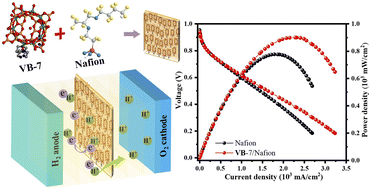
The integration of novel fillers with defect engineering serves as an effective strategy for enhancing the performance of Nafion-based proton exchange membranes (PEMs). However, the synergistic modification of Nafion membranes using vanadoborate-based fillers in conjunction with defect engineering remains unexplored. Herein, we report a new borate-deficient decavanadoborate, [NH3CH2CH2NH2CH2CH2NH3]4[V10B24O66H8]·8H2O (denoted as VB), as an efficient modifier for Nafion. Density functional theory (DFT) calculations reveal that borate defects enhance the charge density at vanadium sites in the [V10B24] cluster, thereby strengthening its affinity and adsorption capacity for water molecules. Experimental results confirm that the intrinsic VB exhibits exceptional water retention and proton-conducting properties. When incorporated into Nafion at a loading of 7 wt% (VB-7/Nafion), the composite membrane exhibits a proton conductivity of 1.09 × 10⁻⁴ S cm−1 at 343 K and 100% relative humidity, which is 2.85 times higher than that of pristine Nafion (3.82 × 10⁻⁵ S cm−1). The –NH/–OH groups on VB form hydrogen bonds with Nafion's –SO3H moieties, synergistically lowering the proton-transfer activation energy to 0.283 eV while maintaining high hydration (water uptake: 16.85%). Moreover, VB-7/Nafion demonstrates outstanding durability, retaining 93.1% of its mass after radical exposure and exhibiting thermal stability up to 360 °C. In practical H2/O2 fuel cell tests at 80 °C and 100% RH, the VB-7/Nafion membrane achieves a peak power density of 898 mW cm−2, representing a 16.3% improvement over standard Nafion. This work establishes borate-deficient decavanadoborates as a new class of high-performance PEM additives, enabling concurrent enhancements in conductivity, hydration, and stability for next-generation fuel cells.
- This article is part of the themed collection: Journal of Materials Chemistry A HOT Papers
 Please wait while we load your content...


