


Ultralow-loading Pt single atoms anchored on N-doped carbon-encapsulated Mo2C microspheres for efficient hydrogen evolution

Abstract
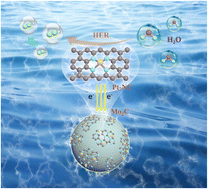
Platinum (Pt)-based materials continue to serve as the benchmark electrocatalysts for the hydrogen evolution reaction (HER), yet their large-scale application is limited by the inherent scarcity and prohibitive cost of platinum. Herein, we develop a Pt-based single atom catalyst comprising Pt atoms anchored in N-doped carbon (NC) encapsulated onto molybdenum carbide (Mo2C) microspheres. Structural analyses reveal an ultra-low Pt loading of 0.156 wt%, characterized by Pt–N4 configurations. Kinetic measurements show that the optimized Pt-NC@Mo2C exhibits exceptional HER performance with an overpotential of 37 mV at 10 mA cm−2 and a Tafel slope of 40 mV dec−1 in acidic solution, outperforming the commercial Pt/C (20 wt%) and most reported Pt-based catalysts. Experimental and theoretical studies demonstrated that the NC layer bridges the Pt atom and Mo2C, which not only stabilizes atomic Pt active sites but also modulates their electronic structures through electron transfer from Pt to Mo2C. This unique composite nanostructure optimizes and facilitates the adsorption of H* intermediates on the Pt-NC@Mo2C, thereby enhancing its HER performance.
- This article is part of the themed collection: Journal of Materials Chemistry A Emerging Investigators 2026
 Please wait while we load your content...


