


A single-phase high-entropy metal phosphide for efficient hydrogen evolution reaction
 b
and
Jinliang
Zhu
*a
b
and
Jinliang
Zhu
*a
Abstract
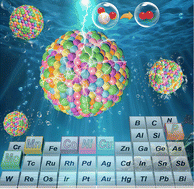
Water electrolysis for hydrogen production is an important pathway for achieving hydrogen energy conversion, but the high cost and scarcity of precious metal catalysts limit its application. This study developed a novel single-phase high-entropy metal phosphide (Mo0.6Co0.5Ni0.4Cu0.3Mn0.2P, HEMP) uniformly anchored on a porous carbon network, synthesized through thermal conversion of cation-bonded phosphate resins. The resulting catalyst exhibits excellent performance for the hydrogen evolution reaction, requiring overpotentials of only 69 mV and 83 mV to achieve 10 mA cm−2 in alkaline freshwater and seawater, respectively, while retaining more than 85% of its initial current density after 200 hours of continuous operation in seawater. Density functional theory calculations reveal that Mo incorporation optimizes hydrogen adsorption free energy, enhances inter-metal electron transfer, and amplifies intrinsic HER activity through the high-entropy effect, outperforming the medium-entropy counterpart (Co0.5Ni0.4Cu0.3Mn0.2P). These results establish a facile route to develop single-phase HEMPs and provide mechanistic insights into their superior activity and durability. They reveal the electronic state modulation induced by high-entropy effects and the structure–activity relationships, thereby promoting the design of efficient non-precious metal electrocatalysts to tap into their application potential in water electrolysis.
 Please wait while we load your content...


