


Engineering a flower-like Cu-BTC/BiOI heterostructure for efficient photodegradation of antibiotics in authentic aquatic environments
 *a
and
Dongxue
Han
*a
*a
and
Dongxue
Han
*a
Abstract
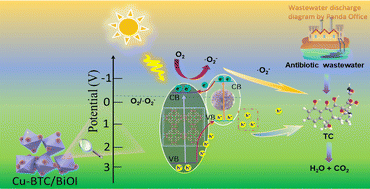
The development of high-performance photocatalysts with large specific surface areas, superior efficiency, and robust stability presents a promising solution for antibiotic pollution in aquatic environments. Metal–organic frameworks (MOFs), particularly Cu-MOF (named as Cu-BTC), have emerged as attractive candidates due to their porous crystalline structure and extensive surface area. However, their limited electrical conductivity hinders practical photocatalytic applications. To address this challenge, a novel MOF-based heterojunction by anchoring BiOI nanosheets onto Cu-BTC (Cu-BTC/BiOI) was ingeniously fabricated. This design effectively suppresses photogenerated electron–hole pair recombination under light irradiation, while the accumulated charges actively participate in redox reactions to generate superoxide radicals (˙O2−), enabling efficient tetracycline (TC) degradation. Moreover, the Cu-BTC/BiOI heterostructure exhibits robust environmental stability, preserving superior photocatalytic performance across a broad pH range, the presence of various coexisting anions, and in complex Pearl River water samples, demonstrating strong potential for the purification of natural water systems. Notably, the proposed TC degradation pathway is inferred from LC-MS analysis, with density functional theory (DFT) calculations of the condensed Fukui index providing insight into the reactivity of specific functional groups. This study not only achieves the successful synthesis of a MOF-based heterojunction photocatalyst but also pioneers a new design paradigm for high-performance antibiotic wastewater remediation systems.
 Please wait while we load your content...


