


 PLATFORM UPDATE:

Room-temperature curing sustainable hybrid cross-linked coating enables efficient dynamic icephobicity of unmanned aerial vehicles
 *a
*a
Abstract
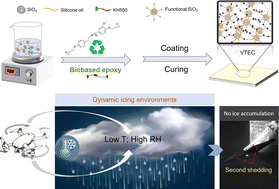
Atmospheric icing represents a significant operational hazard for unmanned aerial vehicles (UAVs), accounting for approximately 1/4 of all UAV-related accidents, predominantly due to compromised flight stability caused by ice buildup. Consequently, there is a pressing need to design an icephobic coating specifically tailored for UAV applications. Although anti-/de-icing coating technologies have made significant progress, their icephobic effect often decreases or completely disappears in actual service environments. Here, a novel composite coating (VTEC) is developed by integrating all biobased epoxy resins with oil-stored nano-silica through a hybrid cross-linked strategy, demonstrating exceptional hydrophobic performance with a 9° sliding angle. The coating's superior lubricating characteristics confer remarkable anti-adhesion, self-cleaning, and de-icing capabilities (ice adhesion strength: 7.8 kPa) while demonstrating exceptional anti-icing and anti-frosting efficacy under dual stressors of cryogenic temperatures and elevated humidity conditions. Comparative analysis reveals that VTEC achieves a 19.5-fold increase in freezing delay duration and approximately 300% extension in frosting time relative to superhydrophobic coating (SHC), highlighting its superior performance under extreme environmental conditions. Notably, VTEC-coated propellers maintained two ice-shedding events during testing while SHC-coated surfaces failed completely, resulting in 91.6% energy savings. Beyond ice resistance, the multifunctional coating provides ultraviolet (UV) shielding, corrosion inhibition, antibacterial properties, self-healing capabilities, and recyclability. This technological progress could notably enhance the operational versatility of drones under harsh environmental conditions.
 Please wait while we load your content...


