


Coulombic efficiency-driven optimization of health-aware charging protocols: an experimental investigation on LCO/graphite lithium-ion cells

Abstract
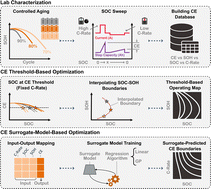
Fast charging of lithium-ion batteries requires carefully designed protocols that maximize charge throughput while minimizing capacity degradation. Here, we present a new framework that leverages coulombic efficiency (CE) as both a degradation metric and an adaptive constraint on C-rate selection for charging profile optimization. We first perform state-of-charge (SOC) and C-rate sweep experiments on cells at predefined state-of-health (SOH) levels, measuring CE at multiple C-rates across the full SOC range to construct a comprehensive dataset mapping from SOC, SOH, and C-rate to CE (i.e., (SOC, SOH, C-rate) → CE). Two CE-driven approaches are proposed. The first is a threshold-based charging protocol that segments the SOC range based on a fixed CE cutoff and assigns C-rate limits to each segment to prolong cycle life. The second approach is a surrogate model-based optimization, where linear and GP regressions, trained on the (SOC, SOH, C-rate) → CE dataset, predict capacity fade and guide a nonlinear program that minimizes charging time under a specified fade constraint. Both approaches are implemented with different SOC discretizations and benchmarked against their non-adaptive counterparts, standard constant-current/constant-voltage (CCCV) baselines, and a physics-based model calibrated using CE data. Experimental validation on commercial LCO/graphite cells, with reference performance tests every four cycles and adaptive re-optimization as the cell degrades, shows that the linear-surrogate-based protocol achieves a strong speed-lifetime compromise: it charges nearly as fast as the constant 3C CCCV baseline while extending cycle life by a factor of ∼2.3. The threshold-based protocol provides the greatest longevity of all fast charging protocols considered, sustaining ∼11.5× the lifetime of the 3C CCCV baseline and exceeding that of the 2C CCCV baseline, while maintaining competitive charging speed. This CE-driven framework thus provides a versatile, data-driven pathway for designing fast charging protocols that effectively balance charging speed with battery longevity. Practical considerations for deployment and physics-based insights into the dominant CE-linked mechanisms of plating and SEI growth are also discussed.
- This article is part of the themed collection: Journal of Materials Chemistry A HOT Papers
 Please wait while we load your content...


