


Honeycomb-structured mixed-valence LiV3O8/C with cathode–anode bifunctionality for lithium-ion batteries
 *a
*a
Abstract
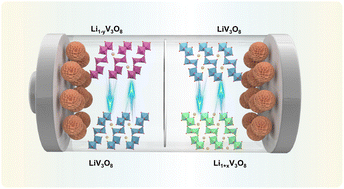
Conventional lithium-ion batteries require distinct cathode and anode materials, leading to complex synthesis, interfacial incompatibility, and limited structural integration. To overcome these issues, honeycomb-like carbon-coated LiV3O8 (H-LiV3O8/C) was designed and synthesized, integrating mixed-valence chemistry with structural engineering to achieve robust ionic and electronic transport. Benefiting from the synergistic coupling between the layered LiV3O8 phase and the conductive honeycomb carbon network, which enables wide-range reversible redox activity, continuous ion/electron transport, and enhanced structural stability, H-LiV3O8/C exhibits high reversible capacity, favorable rate capability, and good cycling stability as both a cathode and an anode. The symmetric H-LiV3O8/C‖H-LiV3O8/C full cell achieves a reversible capacity of 146.57 mAh g−1 with 85.72% capacity retention after 1000 cycles, highlighting reversible Li+ storage across both high and low potential regions. This work demonstrates the feasibility of using a single vanadium-based compound as a bifunctional electrode, enabling simplified yet competitive lithium-ion batteries.
 Please wait while we load your content...


