



Tuning polymorphism, molecular orientation and crystallinity in P(NDI2OD-T2) thin films informed by Hansen solubility analysis
 †*a
and
Christopher R.
McNeill
*a
†*a
and
Christopher R.
McNeill
*a
Abstract
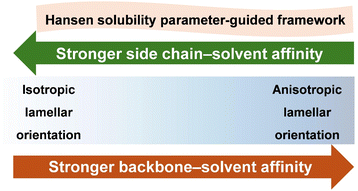
The conjugated polymer P(NDI2OD-T2) is known to exhibit multiple crystalline polymorphs that are typically produced via controlled thermal annealing (TA). Informed by Hansen solubility analysis, we study how different solvents with varying interaction between the alkyl side chains and the aromatic backbone of the polymer affect the different polymorphs of P(NDI2OD-T2) during solvent vapor annealing (SVA). Good solvents such as chloroform (CF) and chlorobenzene (CB) with good affinity for both side chains and backbones are found to be capable of effecting changes between different packing motifs. In contrast, 1-chloronaphthalene (CN), with selective affinity for the backbone but poor affinity for side chains, is found to have little to no impact on structural packing and ordering, while 2-methyltetrahydrofuran (MeTHF) with selective affinity for the side chains has an intermediate effect. The combination of TA and SVA provides a pathway to access thin films with different characteristics of the various polymorphs. By calculating the interactive distance between P(NDI2OD-T2) side chain and solvents (Ra-side chain), and between P(NDI2OD-T2) backbone and solvents (Ra-backbone), clear correlations between these two parameters and the Herman orientation parameter and thin film crystallinity emerge. A systematic decrease in the Herman orientation parameter and systematic increase in the fraction of crystallites is evidenced with increasing Ra-side chain. Meanwhile, a systematic increase in the Herman orientation parameter and decrease in the fraction of crystallites is observed with increasing Ra-backbone. The Hansen parameter-guided framework established here could be used as a generalized strategy for tuning polymorph, orientation, crystallinity in other CPs with similar side chain/backbone structures.
 Please wait while we load your content...


