


Trinuclear copper supramolecular frameworks for boosting the electrocatalytic reduction of CO2 to C3 products
 b
Yaobing
Wang
*abcde
b
Yaobing
Wang
*abcde
Abstract
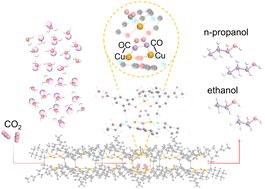
The electrocatalytic reduction of CO2 to liquid fuels provides a compelling pathway towards the storage and conversion of renewable energy. However, designing suitable catalysts to improve liquid product selectivity remains challenging. Herein, the trinuclear copper supramolecular frameworks Cu3–HCOO and Cu3–SO4 were designed and constructed by an aldehyde amine condensation reaction and a metal self-assembly reaction, and they contained three Cu active center sites and had the ability to generate multi-carbon products in the electrochemical CO2 reduction reaction (CDRR). Trinuclear molecular Cu3–SO4 exhibited 5.57% n-propanol faradaic efficiency (FE(n-PrOH)) in the electrochemical CDRR process. By replacing the anionic groups on Cu sites, Cu3–HCOO further exhibited an FE(n-PrOH) of 6.76%. This efficiency of C3 product generation remains at a moderate level compared to that of C1/C2, and it still presents a challenging reaction. In addition, in situ FTIR and 13C isotope results further indicated that the HCOO group on trinuclear Cu promoted the generation of CO and the subsequent C–C coupling process, thereby achieving the generation of n-PrOH. Furthermore, theoretical calculations confirmed the thermodynamic feasibility of Cu3–HCOO catalyzing the conversion of CO2 to n-PrOH. This work provides new ideas for the design of polynuclear metal molecule catalysts and their application in CO2 reduction, offering new insights for the development of multi-carbon product systems.
- This article is part of the themed collection: Journal of Materials Chemistry A HOT Papers
 Please wait while we load your content...


