


 PLATFORM UPDATE:


Realizing ultralow lattice thermal conductivity in CuInTe2 by controlled cation disorder
 a
and
Gangjian
Tan
*ab
a
and
Gangjian
Tan
*ab
Abstract
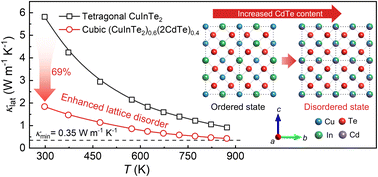
Tailoring structural disorder enables phonon transport manipulation, providing a viable route toward ultralow lattice thermal conductivity and high thermoelectric performance. Here, CdTe alloying is used to modulate the cation-sublattice configuration of CuInTe2 and to investigate how atomic disorder influences heat and charge transport. The introduction of Cd promotes a gradual structural transition from an ordered tetragonal structure to a disordered cubic structure, accompanied by enhanced Cu–In cation intermixing. Such disorder, arising from the cooperative formation of Cd substitutional and Cu–In antisite defects together with intrinsically weaker Cd–Te bonds, strengthens point defect scattering and induces pronounced lattice softening. As a result, the lattice thermal conductivity decreases to 0.44 W m−1 K−1 at 873 K, approaching the amorphous limit. However, excessive disorder intensifies carrier scattering and deteriorates electrical transport, while moderate cation disorder achieves a favorable phonon–carrier trade-off, yielding a peak ZT of 0.75 at 873 K for (CuInTe2)0.9(2CdTe)0.1. This work demonstrates that controlled cation-sublattice disorder effectively modulates phonon scattering, providing insight into designing chalcopyrite thermoelectric materials with intrinsically low lattice thermal conductivity.
- This article is part of the themed collection: Thermoelectric energy conversion
 Please wait while we load your content...


