


Deciphering the dynamic behavior of geminal-Cu sites for high-efficiency reduction of nitrate to ammonia
 a
and
Wei
Lin
*ab
a
and
Wei
Lin
*ab
Abstract
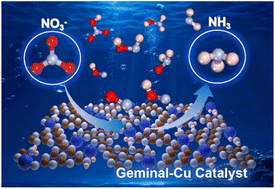
The nitrate reduction reaction (NO3RR), an innovative dual technology for water pollution remediation and ammonia (NH3) production, has emerged as an effective strategy to address the imbalances in the global nitrogen cycle. In this work, the catalytic behavior of a novel 2D material featuring geminal-Cu (Cug) atoms anchored on polymeric carbon nitride (Cug/PCN) for the NO3RR was analyzed via density functional theory calculations. The results reveal that the electronic delocalization of the Cug/PCN catalytic material and the d–p orbital coupling between Cug atoms and nearby N atoms can modify the electronic structure of the active site, boosting the activation of nitrate. The dynamic change of the Cu–Cu distance facilitates to the formation of the *NHO intermediate rather than *NOH through a bridging mechanism, which results in a remarkably low potential-determining step of 0.02 eV and superior NO3RR performance. This work identifies a structure–activity relationship of Cug/PCN for the NO3RR, which offers feasible theoretical and experimental guidance for designing materials based on geminal-metal atoms.
 Please wait while we load your content...


