



Inert nickel doping unlocking aqueous proton storage by hydrated copper hexacyanoferrate as a competitive cathode for proton pseudocapacitors

Abstract
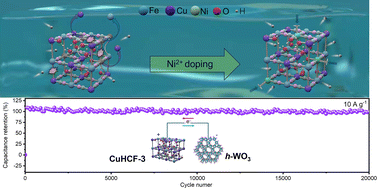
Proton pseudocapacitors (PPCs), utilizing the smallest charge carrier H+ to achieve ultrafast kinetics through the Grotthuss mechanism, exhibit attractive advantages of high safety, environmental compatibility, and abundant resource availability. However, the development of PPCs with high energy and high-power density, and long service life has been limited seriously by the constraints of cathode materials. Herein, an inert hetero-atomic Ni-doping strategy has been smartly designed to optimize copper hexacyanoferrate (CuHCF) toward producing PPCs as competitive cathodes. With purposeful Ni2+ doping, abundant defects are introduced along with an optimized framework structure, which enhances the hydrogen-bonding network within the framework, facilitating H+ transport and subsequent outstanding rate capability. Moreover, the doped Ni as the structural anchor mitigates ion displacement, favoring enhanced cycling stability for electrodes. As a result, compared with pristine CuHCF, the optimized cathode CuHCF-3 (i.e., Ni0.14Cu0.86[Fe(CN)6]0.61·□0.39·4.35H2O) exhibits exceptionally high rate capabilities and cycling properties. More impressively, the assembled asymmetric PPCs achieve a high energy density of 25.1 Wh kg−1 at 20 kW kg−1, and approximately 100% capacitance retention after 20 000 cycles at 10 A g−1. Our contribution here provides new insights into the rational design of reliable cathode platforms for efficient aqueous proton storage.
- This article is part of the themed collections: Journal of Materials Chemistry A HOT Papers and Supercapacitors for a sustainable energy future
 Please wait while we load your content...


