


Construction of carbon-based frustrated Lewis pairs for sustainable hydrogen evolution through heteroatom bond formation
 c
and
Lei
Liu
*ab
c
and
Lei
Liu
*ab
Abstract
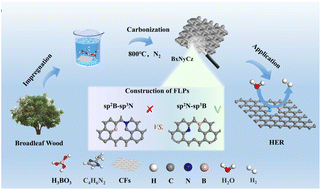
Biochar, a cost-effective and abundant carbon material exhibiting robust stability across acidic and alkaline environments, emerges as a viable sustainable alternative to metal-based catalysts. However, its inherent catalytic activity for the hydrogen evolution reaction (HER) remains limited by sluggish water dissociation and dehydrogenation kinetics. To address this limitation, boron (B) and nitrogen (N) atoms are selected as the Lewis acid/base sites for establishing FLPs on biochar surfaces. DFT-guided catalyst design is used to systematically evaluate the impact of B/N site spacing and coordination environments. Theoretical calculations revealed that configurations with pyridinic-N (Nsp2) and BC3 (Bsp3) in the para-position exhibit optimal HER performance. Guided by these results, the focus of experimental efforts is on synthesizing biochar enriched with pyridinic-N and BC3 species (B1N3C800). B1N3C800 delivers exceptional experimental HER performance, achieving low overpotentials of 82 mV (acidic) and 249 mV (alkaline) at 10 mA cm−2. This theory-driven FLP design strategy provides fundamental insights into the development of high-performance biochar-based electrocatalysts.
 Please wait while we load your content...


