


Altering the deposition behavior and enhancing the interface stability via a gradient-potassiophilic scaffold achieve a highly efficient and dendrite-free potassium metal anode
Abstract
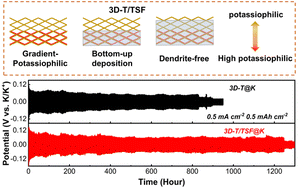
The practical application of potassium metal batteries (PMBs) has been hindered by serious dendrite growth and volume variation on the potassium (K) metal anode. Altering the deposition behavior of K metal by designing a three-dimensional (3D) scaffold is an ideal strategy to inhibit the dendrite growth and volume variation. Here, a self-standing and gradient-potassiophilic 3D porous scaffold composed of Ti3CN on the separator side and Ti3CN and SnF2 nanoparticles on the anode side (named 3D-T/TSF) is designed to modify the K metal anode, achieving excellent electrochemical performance. The potassiophilicity of the 3D-T/TSF scaffold increases in gradient along the direction perpendicular to the electrode, which induces the preferential deposition of K metal within the 3D-T/TSF scaffold. Such deposition behavior could fully occupy the internal pore structure of the scaffold, inhibiting the K dendrite growth and relieving the volume variation. In addition, an inorganic SEI layer rich in K–Sn alloy, SnO2, and KF is spontaneously formed at the interface between the anode and electrolyte to enhance the stability of the K anode. Consequently, the 3D-T/TSF@K//3D-T/TSF@K symmetric battery presents a long cycle lifespan of over 1200 h at 0.5 mA cm−2. The 3D-T/TSF@K//PTCDA full battery delivers a capacity retention of 88.5% after 100 cycles at 1C. The design of the gradient-potassiophilic 3D porous scaffold provides a new direction for the construction of stable K metal anodes, which is beneficial for promoting the practical application of PMBs.
 Please wait while we load your content...


