


Unveiling the role of electrode architecture and illumination direction in heterojunction photo-supercapacitors performance and charge storage mechanism

Abstract
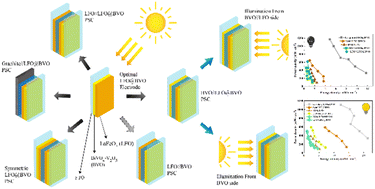
We systematically investigate the effects of electrode architecture and illumination direction on the performance of five heterojunction-based photo-supercapacitor (PSC) configurations. Symmetric and asymmetric devices combine LaFeO3@BiVO4-V2O5 (LFO@BVO) heterojunction, graphite, LaFeO3, and BiVO4-V2O5 electrodes, and are evaluated under both dark and illuminated conditions. The symmetric LFO@BVO photo-supercapacitor shows more than a fourfold increase in capacitance under illumination, nearly matching the performance of the asymmetric Graphite//LFO@BVO device. Additionally, we conduct a detailed study of directional illumination on the asymmetric BVO//LFO@BVO PSC to examine its architecture-driven photoresponse. This study demonstrates that illumination direction strongly influences charge storage behavior. The best-performing device achieves an energy density of 21.4 mWh cm−2 under illumination at 335.4 mW cm−2. These findings significantly advance the design of photo-supercapacitors and support the development of integrated systems for simultaneous solar energy harvesting and storage.
 Please wait while we load your content...


