


Engineering Brønsted acidity in metal–organic gels via d0-electron configuration for wide-temperature anhydrous proton conduction
 *a
and
Xiaoqin
Zou
*b
*a
and
Xiaoqin
Zou
*b
Abstract
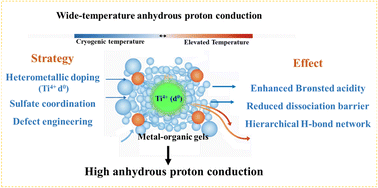
The development of solid-state proton conductors that operate efficiently across a wide temperature range, from sub-zero to elevated temperatures, remains a significant challenge, hindered by the inherent limitations of water-dependent materials. Herein, we introduce heterometallic sulfates into a bimetallic metal–organic gel (M/Zr-FA-xerogel) via a one-pot synthesis, resulting in the formation of a hierarchical proton conduction network. This innovative strategy concurrently addresses the quantity, quality, and connectivity of proton carriers. In this network, structural defects enhance carrier concentration, while sulfate groups establish extensive hydrogen-bonding pathways. Importantly, we demonstrate that the intrinsic Brønsted acidity of defect sites can be rationally tuned by manipulating the electronic structure of the dopant. Specifically, the d0 electronic configuration of Ti4+ serves as an effective electron sink, significantly reducing the proton dissociation barrier, which is critical for cryogenic transport. This integrated design culminates in an adaptive conduction mechanism that transitions from being dominated by acid strength at low temperatures to being limited by carrier concentration at high temperatures. As a result, the optimized Ti/Zr-FA-xerogel exhibits an exceptional anhydrous conductivity of 1.9 × 10⁻³ S cm−1 at 233 K, surpassing its counterpart by 3 orders of magnitude, and 5.0 × 10⁻² S cm−1 at 433 K. This research not only develops a novel design strategy for proton conductors operable across a wide temperature range, but also elucidates the intricate interplay between electronic structure, defect chemistry, and proton dynamics in amorphous coordination polymers.
 Please wait while we load your content...


