


Multi-shell nanostructures minimize diffusion pathways and dual active sites decouple activation for efficient ammonia borane hydrolysis
 *a
*a
Abstract
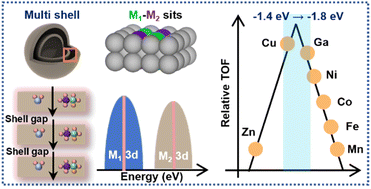
The development of efficient non-noble metal catalysts for low-energy, high-safety hydrolysis of ammonia borane (AB) is critical to advancing hydrogen generation technologies. Current catalysts face two main challenges: sluggish diffusion and competitive activation of liquid-phase molecules (H2O and AB) on single metal sites, causing low efficiency. To address these limitations, we adopt two strategies: (1) the fabrication of multi-shell hollow sphere architectures to minimize reactant diffusion pathways and (2) the integration of dual reaction sites to decouple the activation of reactants. This study diverges from trial-and-error experimentation by employing integrated theoretical and experimental methodologies. Theoretical modeling shows that optimal shell thicknesses are below 0.98 and 12.49 µm for AB and H2O, respectively. We selected Zn, Mn, Ni, and Cu from seven common metal oxides as secondary reaction sites for Co3O4 catalysts based on their affinity for reactants. Experiments revealed that the multi-shell structure increased the catalyst's specific surface area from 25 to 98.26 m2 g−1, reducing reactant diffusion distance. Dual reaction sites enabled selective activation of reactants, with activity order Cu > Ni > Mn > Zn for modified Co3O4 catalysts. Enhanced catalytic performance correlates with improved charge localization and electron transfer, lowering H2O and AB dissociation energy barriers by 8-fold and 1.5-fold, respectively. Reactant binding energies align linearly with the catalyst's d-band center, and catalytic activity shows a volcano-shaped correlation with dopant-induced d-band center shifts, consistent with the Sabatier principle. The optimal dopant d-band center is between −1.4 and −1.8 eV. In general, this work offers a design reference for mass transfer and chemical reaction enhancement of AB hydrolysis catalysts.
 Please wait while we load your content...


