


Exploring the electrocatalytic performance of PdIrSnZnMo high entropy alloy (HEA) towards the hydrogen evolution reaction in an acidic medium: a theoretically supported approach

Abstract
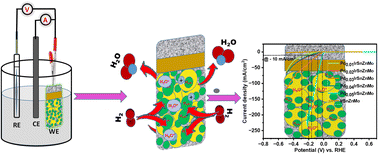
High entropy alloys (HEAs) are a versatile class of electrocatalysts with tunable surface properties, compositions, and synergistic elemental effects, notably enhancing the hydrogen evolution reaction (HER). Herein, we report the development of PdIrSnZnMo HEAs with varying Pd loadings (0.01–0.05 M) using a facile solvothermal method. The structural features and composition of the prepared PdIrSnZnMo HEA nanostructures were characterized using X-ray diffraction (XRD), X-ray photoelectron spectroscopy (XPS), field emission scanning electron microscopy (FESEM), and high-resolution transmission electron microscopy (HR-TEM). Systematic electrocatalytic studies revealed a remarkable HER performance even at a low Pd loading (0.01 M). Notably, the PdIrSnZnMo HEA with 0.05 M Pd exhibited an ultra-low overpotential of 17 mV to achieve a current density of −10 mA cm−2 in an acidic medium, surpassing the conventional Pt/C electrocatalyst. The electrocatalyst also demonstrated outstanding durability and maintained its stability without decomposition during prolonged operation. Density functional theory (DFT) calculations elucidated the surface atomic configurations of the PdIrSnZnMo HEA, highlighting the role of Pd active centers coordinated by Ir, Sn, Zn, and Mo. This study presents versatile nanostructured HEA systems and a straightforward synthetic strategy with broad implications for catalysis in energy conversion applications.
- This article is part of the themed collection: Celebrating International Women’s Day 2026: Women in Journal of Materials Chemistry A
 Please wait while we load your content...


