


Enhancing carrier lifetime in SrTiO3via metallic doping: insights from first-principles calculations and non-adiabatic molecular dynamics
 *a
and
Rajeev
Ahuja
b
*a
and
Rajeev
Ahuja
b
Abstract
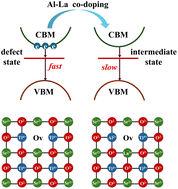
In this work, the suppression of oxygen-vacancies and Ti3+ intermediate states inherent in the SrTiO3 lattice through metallic doping has been shown to be an effective way to enhance the carrier lifetime of the material. Combining the first-principles and nonadiabatic molecular dynamics (NAMD) techniques, we unveil the effects of Al/La single doping and co-doping on carrier lifetime for the first time. The results show that when single doping is used, the trap states caused by oxygen defects can be effectively eliminated when two Al3+ ions replace two Ti4+ ions, while the defect states still exist when two La3+ ions replace two Sr2+ ions. In contrast, Al–La co-doping not only successfully eliminates the trap states caused by oxygen defects through the synergistic effect, but also significantly extends the carrier lifetime to 327.87 ns. Meanwhile, the increase of carrier concentration enhances the conductivity of the system. Al–La co-doping further hinders the complex carrier recombination process through the acceleration of quantum decoherence induced by the localized wave function and mid-frequency phonons. This study not only provides important theoretical guidelines for the development of high-performance doped SrTiO3 but also deepens the physical understanding of complex carrier dynamics.
 Please wait while we load your content...


