


Confining the FeSe/NiSe heterostructure in in situ formed carbon microspheres for high-efficiency sodium storage

Abstract
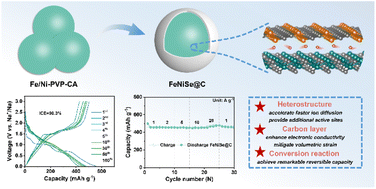
Metal selenides (MSes), which are prospective anode materials for sodium-ion batteries (SIBs), offer high theoretical capacity. However, their commercialization is hampered by unsatisfactory long-term cyclability and rate performance, mainly on account of significant volume variations and sluggish ion diffusion kinetics during cycling. Herein, a composite comprising an FeSe/NiSe heterostructure with an in situ formed carbon layer (FeNiSe@C) is successfully fabricated via solvothermal and selenization–co-carbonization methods. The synergistic effect between the outer carbon layer and the heterostructure facilitates rapid Na+/electron transport and effectively alleviates structural degradation during prolonged cycling. Benefiting from the above merits, FeNiSe@C exhibits excellent electrochemical performance, featuring a high initial coulombic efficiency (90.3%) and durability for 4000 cycles at 10 A g−1 (461.4 mAh g−1), alongside rate capability (468.1 mAh g−1 even at 20 A g−1). Moreover, the Na+ storage mechanism and fast ion transport kinetics are elucidated through in/ex situ characterization, electrochemical kinetic analysis, and distribution of relaxation times analysis. This work emphasizes the critical importance of heterostructure engineering in the design of advanced electrode materials for high-performance SIBs.
- This article is part of the themed collection: Journal of Materials Chemistry A HOT Papers
 Please wait while we load your content...


