Gradient-multiscale-interconnected architectures enable waterborne superomniphobic surfaces to resist the high-strength impact of solids and fluids

Abstract

A bottom-up waterborne emulsion system is developed to construct gradient-multiscale-interconnected (GMI) architectured superomniphobic surfaces (SOSs). The GMI architectures are verified to be of both high mechanical flexibility and trapped-air stability, making SOSs resistant to high-strength impact of solids and fluids and thus competent for for real-world dynamic long-term applications.
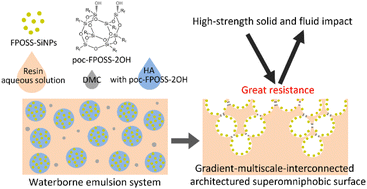
Graphical abstract: Gradient-multiscale-interconnected architectures enable waterborne superomniphobic surfaces to resist the high-strength impact of solids and fluids

Supplementary files

Article information

Article type
Communication
Submitted
01 Oct 2025
Accepted
24 Nov 2025
First published
25 Nov 2025

J. Mater. Chem. A, 2026, Advance Article

Gradient-multiscale-interconnected architectures enable waterborne superomniphobic surfaces to resist the high-strength impact of solids and fluids

F. Suo, B. Chen, Z. Lin, X. Yan, Y. Zhai, J. Zhong and J. Liao, J. Mater. Chem. A, 2026, Advance Article , DOI: 10.1039/D5TA08033A

To request permission to reproduce material from this article, please go to the Copyright Clearance Center request page.

If you are an author contributing to an RSC publication, you do not need to request permission provided correct acknowledgement is given.

If you are the author of this article, you do not need to request permission to reproduce figures and diagrams provided correct acknowledgement is given. If you want to reproduce the whole article in a third-party publication (excluding your thesis/dissertation for which permission is not required) please go to the Copyright Clearance Center request page.

Read more about how to correctly acknowledge RSC content.

Social activity

Spotlight

Advertisements