


Molecular linker engineering CdS/Cu2ZnSn(S,Se)4 interface for efficient photovoltaics

Abstract
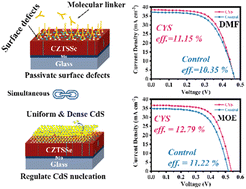
A high-quality CdS/Cu2ZnSn(S,Se)4 (CZTSSe) heterojunction interface is considered essential for obtaining efficient CZTSSe solar cells. However, the inherent surface defects of CZTSSe films, along with the non-uniform nucleation of CdS, pose non-negligible challenges to constructing a high-quality heterojunction. In this work, we proposed an innovative molecular linker strategy for dual-sided modulation of CdS/CZTSSe heterojunction, simultaneously passivating CZTSSe surface defects and regulating uniform CdS nucleation. We systematically screened 10 amino acid-based molecules and identified cysteine (Cys) as exhibiting outstanding bifunctional properties. The introduction of Cys improved device efficiency from 10.35% to 11.15% in the dimethylformamide (DMF) solution preparation system, and significantly enhanced efficiency from 11.22% to 12.79% in the 2-methoxyethanol (MOE) solution preparation system, demonstrating the broad applicability of this strategy. Experimental and theoretical analyses revealed that the passivation effect of Cys primarily originated from the effective interactions between its thiol (–SH) and amino (–NH2) groups and the intrinsic surface defects of CZTSSe, leading to stable defect passivation. Meanwhile, the outward-facing carboxyl (–COOH) group in Cys helped homogenize the nucleation sites on the CZTSSe surface, promoting the dense and uniform nucleation of CdS. This work established a scalable strategy for interfacial optimization, advancing the development of CZTSSe thin-film photovoltaic devices.
 Please wait while we load your content...


