


 PLATFORM UPDATE:


Post-polymerization modification towards polymer-supported metalloporphyrins for heterogeneous electrocatalysis
 *a
and
Zhongfan
Jia
*a
*a
and
Zhongfan
Jia
*a
Abstract
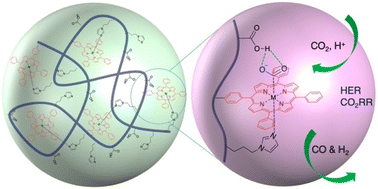
Metalloporphyrins and associated ligands of amino acids form the key cofactors in many redox enzymes. Mimicking such a core function of redox enzymes remains a compelling approach for catalyst design. While most designs focus on a single molecular metalloporphyrin and pendant ligand, it is attractive to integrate such a design into a polymer, which could form an enzyme-like microenvironment through its random-coil and globular conformations. In this study, we introduce a one-pot method for effectively conjugating metalloporphyrins and imidazole groups to a commercially available polymer. Multiple metalloporphyrins were incorporated onto a commercially available polymer to form catalyst P1, followed by a reaction of the same polymer with excess imidazole groups to afford catalyst P2. We examined this concept using Zn, Co, and Cu as metal centers for chemical characterization and electrochemical OER, HER, and CO2RR. The results suggest that P1-Co exhibited a larger catalytic current and Tafel slope than P2-Co. While P1-Cu predominantly catalysed the HER, P2-Cu is the only catalyst in this study that showed significant activity in reducing CO2 to CO. The carboxylic acid groups can act as distal groups and the imidazole groups as axial ligands, thereby enhancing the catalytic capability and selectivity compared with metalloporphyrins. Although there is room for further improvement in catalytic performance, this work demonstrates the advantages of incorporating intramolecular distal groups and axial ligands in a polymer chain to closely mimic enzyme-based catalysts. The synthetic strategies should inspire the synthesis of other polymer-supported heterogeneous catalysts that require ligands and/or distal groups to enhance their catalytic performance.
- This article is part of the themed collections: Advanced Nanomaterials for Sustainable Green Hydrogen Production and Celebrating International Women’s Day 2026: Women in Journal of Materials Chemistry A
 Please wait while we load your content...


