


Polystyrene brush-supported dual Ir complex/N-heterocyclic carbene catalysts for efficient complex three-component dual-catalyzed photocatalysis
 *a
*a
Abstract
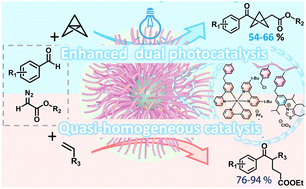
The key limitations of dual catalysis in heterogeneous multi-component photocatalysis include the cumbersome immobilization of dual catalysts, insufficient electron/energy transfers and limited mass transfer of reactants. This study develops a one-pot strategy for the direct co-immobilization of dual Ir(ppy)2(dtbpy)PF6 (IrPD) and 3-(2,6-diisopropylphenyl)-5,6,7,8-tetrahydro-4H-cyclohepta[d]thiazol-3-ium perchlorate (NHC) via Friedel–Crafts alkylation onto the linear poly(4-vinylbenzyl chloride) (PVBC) brushes grafted on SiO2 nanospheres. In comparison to dual IrPD and NHC anchored within pore channels, the PVBC brush-supported dual IrPD and NHC show enhanced optical properties, including improved light-harvesting, lower optical bandgap energy, prolonged fluorescence lifetime, and higher quantum yield. Furthermore, the open-ended structure and the good dispersibility of PVBC brushes in organic solvents enable the anchored IrPD and NHC to promote photocatalytic reactions in a quasi-homogeneous manner. Owing to enhanced electron/energy/mass transfers, the PVBC brush-supported IrPD and NHC achieve comparable catalytic yields to the homogeneous combination of IrPD and NHCs in complex three-component photocatalysis. Overall, this work establishes an effective quasi-homogeneous photocatalytic platform suitable for complex multi-component and multi-catalytic reactions for the low-cost and sustainable synthesis of fine chemicals.
- This article is part of the themed collection: Advances in Sustainable Catalysis: from Materials to Energy and Environmental Applications
 Please wait while we load your content...


