


 PLATFORM UPDATE:


An efficient and durable electrocatalyst for electrochemical water splitting: WCuBP micro-leaf-clusters

Abstract
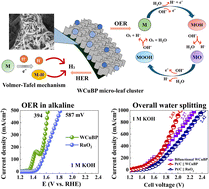
Electrochemical water splitting is a promising approach for green hydrogen production, which can significantly contribute to carbon neutrality by reducing reliance on fossil fuels and minimizing harmful emissions. Developing cost-effective, efficient and durable electrocatalysts is essential for the widespread implementation of sustainable green hydrogen. Herein, a WCuBP micro-leaf cluster (MLC) is demonstrated for overall water splitting via a single-step hydrothermal approach followed by vacuum annealing for the first time. The WCuBP MLC electrocatalyst exhibits outstanding hydrogen evolution reaction (HER) and oxygen evolution reaction (OER) activity, with 51 and 140 mV overpotentials at 50 mA cm−2 in 1 M KOH. The bifunctional WCuBP‖WCuBP system outperforms the benchmark system with a low cell voltage of 2.27 V at 1000 mA cm−2. Furthermore, bifunctional WCuBP demonstrates superior long-term stability, operating continuously for over 120 hours without noticeable performance degradation. The hybrid system of Pt/C‖WCuBP exhibits a lower cell voltage of 2.03 V at 1000 mA cm−2, outperforming both the bifunctional and benchmark systems, showing the successful integration of WCuBP MLC on the anodic side. The superior electrochemical performance of WCuBP can be attributed to the synergistic interactions among W, Cu, B and P along with its high active surface area and enhanced charge transfer kinetics.
 Please wait while we load your content...


