


Design of multibranched diketopyrrolopyrrole polyelectrolytes as versatile materials for efficient photocatalytic hydrogen evolution and organic solar cells

Abstract
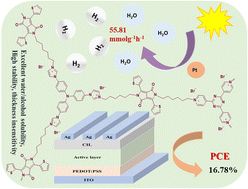
Organic semiconductors are attracting increasing attention for both photocatalytic applications and organic solar cells (OSCs). However, achieving highly efficient photocatalytic hydrogen evolution and high power conversion efficiencies (PCEs) in OSCs remains a significant challenge. Herein, we synthesized a series of multibranched polyelectrolytes (MBPs), namely DTP, DTIP, and DTPTIP, by covalently attaching diketopyrrolopyrrole (DPP)-bearing soft alkyl chains to central triphenylamine or triazine cores. An interesting finding is that the synergistic integration of both triphenylamine and triazine cores within a single DPP-based architecture (DTPTIP) leads to a marked improvement in photovoltaic efficiency and photocatalytic activity. In comparison to linear polyelectrolytes, MBPs with quaternized functionalities exhibit enhanced hydrophilicity, greater dispersity, smaller contact angles, and reduced charge transport resistance. These properties collectively contribute to improved photocatalytic hydrogen evolution reaction (HER) activity. Among the three MBPs, DTPTIP showed superior performance, delivering a hydrogen production rate of 55.81 mmol g−1 h−1 outperforming DTIP (39.86 mmol g−1 h−1) and DTP (31.93 mmol g−1 h−1). In OSC systems, MBPs function as cathode interface layers (CILs), reducing the work function of the metal electrodes and facilitating electron transport, thereby improving the photovoltaic performance. Notably, DTPTIP achieved an impressive PCE of 16.78% in PM6:EH-HD4F-based OSC systems. Furthermore, DTPTIP demonstrated excellent thickness insensitivity; at a CIL thickness of 40 nm, the PCE stabilized at 15.52%, underscoring its feasibility for large-scale OSC fabrication. Overall, this study highlights the potential of MBPs, especially DTPTIP, as versatile materials for both high efficiency photocatalysis and next-generation OSCs.
 Please wait while we load your content...


