


Dual-functional perylene diimide derivative for efficient organic solar cells and interfacial solar steam generation
 *a
and
*a
and
Abstract
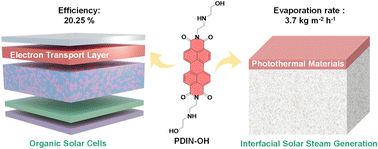
Perylene diimide derivatives are widely utilized in organic semiconductors, energy catalysis, and biomedical applications, due to their high conjugated structures, excellent electron affinity, and strong light absorption. In this work, we found that the perylene diimide derivative (PDIN-OH) is endowed with prominent hydrophilicity and superior electron mobility through hydroxyl modification, making it perform excellently as an electron transport layer (ETL) in organic solar cells (OSCs) and as a photothermal material for interfacial solar steam generation (ISSG). PDIN-OH as an ETL for binary OSCs yielded an impressive efficiency of 20.25%, attributed to its high mobility and matched energy level. Most importantly, PDIN-OH achieves a high evaporation rate of 3.7 kg m−2 h−1 under one sun illumination when used as a photothermal material in ISSG. This remarkable evaporation rate stems from the strong light absorption and the hydroxyl groups of PDIN-OH, which significantly reduce the enthalpy of water evaporation to 1089 J g−1. This study highlights a class of high-performance bifunctional PDI materials and offers a valuable reference for future research.
 Please wait while we load your content...


