


Decoupling the crucial architectures of carbon supports governing Pt nanoparticle anchoring behaviour for electrocatalytic hydrogen evolution
 *a
Yong
Chen
*ab
*a
Yong
Chen
*ab
Abstract
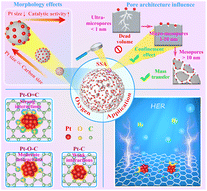
Porous carbons have garnered broad attention as catalyst supports for maximizing Pt utilization. However, significant challenges persist in the systematic decoupling of crucial carbon architectures governing nanocatalyst anchoring behavior due to the highly correlated nature of multiple carbon structures. Herein, we precisely engineer various carbons with well-defined architectures to isolate and evaluate their individual structural contribution to Pt nanoparticle anchoring. Experimental results reveal three key structure-performance relationships: (1) while increasing the specific surface area (SSA) effectively enhances Pt dispersion, this SSA-driven dispersion strategy becomes ineffective in microporous systems, where the pore accessibility—rather than the total SSA—governs the Pt dispersion quality. (2) Nanopore engineering enables effective Pt nanoparticle stabilization through confinement effects, significantly enhancing catalyst durability, and this stabilization follows a pronounced pore-size-dependent mechanism, with micro–mesopores (1–10 nm) exhibiting optimal effects. (3) Oxygen functionalities exhibit superior Pt-anchoring capability to vacancy defects, with C![[double bond, length as m-dash]](https://www.rsc.org/images/entities/char_e001.gif) O groups triggering stronger metal-support interactions via CO–Pt coordination than C–O species, while excessive CO–Pt coordination may compromise catalytic activity, revealing an important stability–activity balance. Consequently, the rational design of carbon supports with well-engineered micro–mesopores and CO-dominant functionalities enables exceptional catalytic activity and durability. This investigation systematically decouples crucial carbon architectures governing Pt nanoparticle anchoring, providing guidance for engineering carbon-supported catalysts with enhanced catalytic performance.
O groups triggering stronger metal-support interactions via CO–Pt coordination than C–O species, while excessive CO–Pt coordination may compromise catalytic activity, revealing an important stability–activity balance. Consequently, the rational design of carbon supports with well-engineered micro–mesopores and CO-dominant functionalities enables exceptional catalytic activity and durability. This investigation systematically decouples crucial carbon architectures governing Pt nanoparticle anchoring, providing guidance for engineering carbon-supported catalysts with enhanced catalytic performance.
 Please wait while we load your content...


