


 PLATFORM UPDATE:


Cu cluster-anchored bismuthene promoting electrocatalytic reduction of CO2 into C2 products: a theoretical study

Abstract
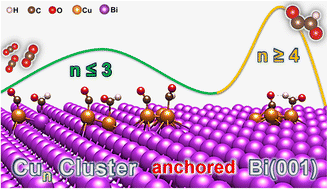
The electrocatalytic CO2 reduction reaction (eCO2RR) to value-added multicarbon (C2) represents a promising carbon-neutral pathway, yet designing efficient catalysts remains challenging. Although Cu-based materials are prominent for C2, their performance requires further optimization. Here, we employ density functional theory (DFT) to investigate atomically precise Cun clusters (n = 1–4) doped on bismuthene (monolayer Bi(001)) as tunable catalysts. Our computations reveal that Cu cluster doped Bi(001) significantly enhances the adsorption capability for key intermediates (COOH* and CO*) and significantly reduces the potential-limiting step (PLS) free energy for CHOCO* formation. However, for Cu1@Bi(001), the local coordination environment resembles that of pristine Bi(001), leading to a similar reaction mechanism 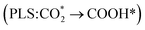 . As the size of Cu clusters increases (Cu2–Cu4), the active sites from Bi–Cu shift to Cu–Cu pairs, inducing a mechanistic shift to Cu(111)-like behavior (PLS: CO* → CHO*). Comparative PLS analysis reveals that Cu cluster doped systems outperform pristine Bi(001), and only controlled Cun clusters (n = 1–3) can effectively enhance the C2 selectivity of bismuthene, whereas excessive Cun cluster incorporation (n = 4) leads to suboptimal performance. Significantly, through energy and electronic structure analyses, we reveal that the adsorption energy differences of key intermediates, their electron transfer ratios and the “Cu–CHO*” bond strength serve as effective descriptors for PLS free energy, providing an indirect measure of catalytic performance. These findings establish bismuthene as a programmable platform for C2 synthesis, demonstrating how atomic-scale synergy between Cu clusters and 2D bismuthene substrates can overcome traditional scaling relations in eCO2RR catalysis.
 Please wait while we load your content...


