


High-throughput screening of Janus t-phase TMXY semiconducting materials for thermoelectric applications aided by machine learning

Abstract
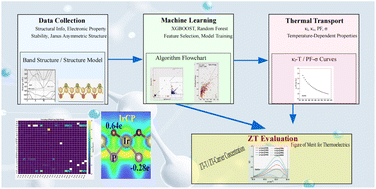
Innovative thermoelectric materials have achieved record-breaking efficiency, with some converting up to 20% of waste heat into electricity, thus playing a crucial role in sustainable energy harvesting and addressing global energy and environmental challenges. Two-dimensional (2D) materials, characterized by their atomic-scale thickness and adjustable electronic and thermal transport properties, present exceptional potential for thermoelectric applications. To efficiently explore this design space, we integrate high-throughput density functional theory (DFT) and machine learning (ML) to screen 2D materials for optimized TE performance, taking Janus t-phase TMXY monolayers (t-TMXYs) as an example. Our workflow utilizes high-throughput DFT to identify dynamically stable Janus configurations based on structural and vibrational stability criteria, followed by ML-assisted prediction of electronic properties (e.g., band structure). We use thermal properties to prioritize candidates (CdOS, ZnSSe, MnNP, and IrCP) for detailed Boltzmann transport theory analysis. This approach reveals that ligand asymmetry in Janus structures drives tunable transport behavior. Specifically, CdOS/ZnSSe possess large bandgaps and flat conduction bands, enhancing the Seebeck coefficient (S) while MnNP/IrCP exhibit complex multi-band hybridization, inducing niche TE regimes. Asymmetric phonon scattering yields low lattice thermal conductivity (κ), amplifying the S2σ/κ scaling, with n-type CdOS and ZnSSe achieving peak ZT ≈ 1.8 and 1.1 at 600 K, comparable to the commercial Bi2Te3. These findings underscore the power of integrated computational approaches in unlocking 2D Janus materials as promising TE candidates for energy conversion applications.
 Please wait while we load your content...


