


Room-temperature electron-selective passivating contact with titanium–peroxo complexes for high-efficiency silicon solar cells

Abstract
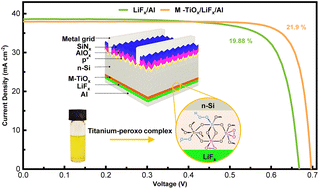
The increasing demand for high-performance and cost-effective solar cells is a driving factor in the development of new nanomaterials or compounds compatible with low-cost, low-temperature fabrication routes. Titanium oxide (TiOx), an inexpensive earth-abundant material, is among the most extensively investigated candidates for electron-selective layer implementation in silicon solar cells. In this context, we investigate the effect of hydrogen peroxide (H2O2) modification of a solution-processed TiOx precursor on the resulting film and device properties. Through various characterization studies, the formation of titanium–peroxo (Ti–OO) complexes upon H2O2 modification is consolidated, and the subsequent structural, optical, and electrochemical properties are examined. Owing to H2O2 modification, an outstanding implied open-circuit voltage (iVoc) of 713 mV and a low contact resistivity (ρc) of 1.96 mΩ cm2 are simultaneously achieved. At the device level, a maximum power conversion efficiency (PCE) of 21.9% is measured for cells incorporating a modified-TiOx/LiFx/Al rear contact, representing a gain of 1.8% compared to control cells with a LiFx/Al rear contact. Notably, this performance is attained using dopant-free standalone TiOx produced at room temperature, without any annealing steps throughout the fabrication process. Stability assessments of unencapsulated devices reveal the superior thermal stability of the modified devices under practical conditions. Moreover, the devices' behavior under illumination is simulated using Solar Cell Capacitance Simulator (SCAPS) software to elucidate the role of modified-TiOx properties in the enhanced photovoltaic (PV) performance metrics. The accomplishments outlined in this study open new avenues for advancing high-efficiency crystalline silicon (c-Si) solar cells through a simplified fabrication process.
 Please wait while we load your content...


