


2D and 3D organic/inorganic hybrid perovskites for electrochemical energy storage applications

Abstract
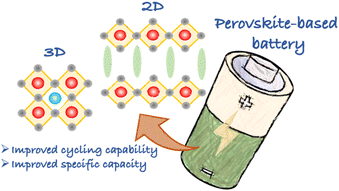
Organic/inorganic hybrid perovskites are attracting research attention due to their great potential in energy storage applications. This study reported three-dimensional (3D) and two-dimensional (2D) lead halide inorganic/organic perovskites used as anode-active materials for Li-ion batteries. A doping strategy was successfully applied to enhance the cycling performance of the 3D hybrid perovskite anode. A moderate amount of chlorine (Cl) was doped into the 3D hybrid perovskite crystals to increase the polarization inside the network and support Li-ion transfer. The Cl-doped 3D hybrid perovskite anodes showed an outstanding improvement in cycling performance up to 1000 cycles at a high current density of 500 mA g−1. Furthermore, three 2D hybrid perovskites (BAPbCl4, BZAPbCl4, and PEAPbCl4) were applied as anode-active materials for the first time. Results revealed that aromatic organic ammonium made a great contribution to battery capacity and stability. The 2D hybrid perovskite anode delivered an excellent capacity of over 1000 mA h g−1 under 100 mA g−1, which is, by far, the highest reported Li-ion storage capacity for perovskite-based anode materials.
 Please wait while we load your content...


