


Simultaneously tackling discrete island effects and interfacial resistance in PEM electrolyzers via a scalable bilayer catalyst design

Abstract
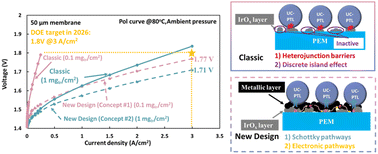
Proton exchange membrane water electrolyzers (PEMWEs) integrated with renewable energy offer a sustainable solution for hydrogen production, yet their reliance on platinum-group metals (PGMs), particular Ir, remains a major barrier to large-scale adoption. Two key bottlenecks in reducing the PGM content have emerged: (i) discontinuous anode layers at <0.5 mgIr cm−2 and (ii) a high interfacial resistance due to the formation of a heterojunction between the IrOx based anode layer and TiOx-passivated porous transport layer (PTL) which are both typically semiconductors. Here, we simultaneously address both challenges with a versatile bilayer anode design. Unlike many catalyst-specific approaches, this concept is broadly applicable, enabling optimization across different catalyst systems. A conduction band model is developed to explain the mechanism of how this novel approach works, and this strategy is then implemented in two new designs: (1) an ultra-low Ir loading (0.1mg cm−2) electrode that meets the DOE 2026 efficiency target (3 A cm−2 @ 1.8 V) and (2) a near-commercial bilayer design (0.7 mgIr cm−2 from IrOx + 0.3 mgIr cm−2 from metallic Ir nanoparticles). Finally, a simple levelized cost of hydrogen (LCoH) analysis, rarely employed in materials-focused studies, demonstrates that the latter design offers the best balance of performance and cost. This work provides a scalable strategy to reduce PGM dependence in PEMWEs while advancing practical pathways for affordable green hydrogen production.
 Please wait while we load your content...


