


Field-induced phase transition behaviour of ferroelectric nematic liquid crystals under DC electric fields

Abstract
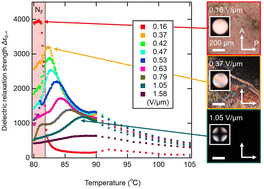
Ferroelectric nematic liquid crystals (FNLCs) exhibit strong polarization responses, yet accurate evaluation of their dielectric properties without polarization contribution, that is, soft-mode-like dielectric permittivity, remains challenging because fluctuations of spontaneous polarization can lead to an apparent overestimation of permittivity. Here, we investigate the dielectric response of a DIO-based FNLC material under DC electric fields and show that the soft-mode-like contribution can be isolated once the director is reoriented perpendicular to the substrates. At field strengths sufficient to induce this vertical alignment, the peak dielectric relaxation strength becomes independent of cell thickness, consistent with effective suppression of the polarization-related contributions. Using this approach, we determine the DC-field dependence of the transition temperature to the ferroelectric phase and show that the relationship between the transition temperature and the DC field changes across field-induced intermediate phases, consistent with differences in the symmetry of their molecular alignment. In particular, at high fields, the transition from a nematic-like intermediate phase to a ferroelectric phase exhibits characteristics of a second-order phase transition. These results establish a practical route to extract reliable dielectric properties of FNLCs and provide a basis for quantitative physical characterization of this class of materials.
 Please wait while we load your content...


