


Electrokinetic and electro-elastic instabilities in viscoelastic microfluidic flows: suppression and augmentation in mixing efficiency
 *a
A.
Chauhan
a
*a
A.
Chauhan
a
Abstract
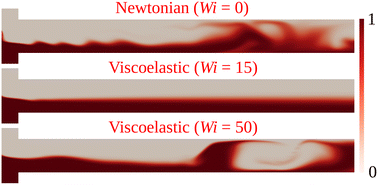
Viscoelastic fluids, such as polymer solutions, surfactant mixtures, colloidal suspensions, emulsions, and biological fluids like blood, are frequently transported in microfluidic systems using external electric fields. In such flows, two distinct types of instabilities can emerge, namely, electro-elastic instabilities (EEI), arising from the interaction between elastic stresses and streamline curvature, and electrokinetic instabilities (EKI), triggered by electrical conductivity gradients once the external electric field exceeds a critical value. Both instabilities can promote fluid mixing by inducing chaotic flow structures; however, their roles are not always complementary. Recent experimental and numerical studies have shown that increasing fluid viscoelasticity can suppress EKI, leading to reduced mixing efficiency in a microfluidic T-junction. However, this study demonstrates that while viscoelasticity initially hinders mixing by damping EKI, a further increase in the Weissenberg number (a measure of fluid elasticity) leads to the onset of EEI, which in turn again increases mixing. Therefore, a non-monotonic relationship between mixing efficiency and Weissenberg number is found in the present study. Furthermore, although both EEI and EKI promote mixing, they differ significantly in their coherent flow structures and regions of origin within the microdevice. To elucidate these differences, we employ the data-driven dynamic mode decomposition (DMD) technique to characterise the underlying instability modes and their influence on the mixing dynamics. Overall, this study provides fundamental insights into how viscoelasticity modulates flow instabilities in electrokinetically driven microflows and offers strategies to optimise mixing by tuning fluid properties and operating conditions.
 Please wait while we load your content...


