



Catching the wave: particle transport by a moving phase boundary
 †a
Jocelyn
Ochoa,
b
Chaitanya
Joshi,
a
Benjamin J.
Stokes,
d
Linda S.
Hirst
c
and
Timothy J.
Atherton
*a
†a
Jocelyn
Ochoa,
b
Chaitanya
Joshi,
a
Benjamin J.
Stokes,
d
Linda S.
Hirst
c
and
Timothy J.
Atherton
*a
Abstract
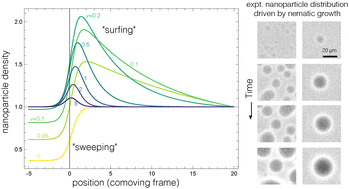
Non-equilibrium particle transport in liquid crystals (LCs) can be exploited to create a variety of complex composite morphologies such as capsules, foams and gels by cooling the system through a phase transition. The mechanisms behind structure formation are however poorly understood. To understand the initial stages of the process, we construct a fundamental model of nanoparticle transport by a moving LC phase boundary by coupling LC physics to the Fokker–Planck equation for transport. Solutions of our model reveal two distinct transport regimes where particles either surf on or are swept up by the moving phase boundary. The model allows us to draw an analogy between the formation and evolution of LC-nanocomposite systems and chemotaxis, thus enriching the space of realizable structures. Fluorescence imaging and analysis of particle transport at a moving isotropic to nematic phase boundary demonstrates that the model successfully predicts experimental observations, enriching our understanding of out-of-equilibrium transport phenomena and phase transition-driven structure selection.
 Please wait while we load your content...


