



Compression-driven jamming in porous cohesive aggregates

Abstract
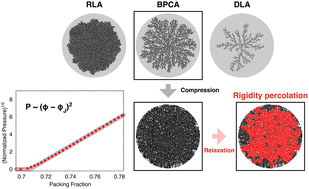
I investigate the compression-driven jamming behavior of two-dimensional porous aggregates composed of cohesive, frictionless disks. Three types of initial aggregates are prepared using different aggregation procedures, namely, reaction-limited aggregation (RLA), ballistic particle–cluster aggregation (BPCA), and diffusion-limited aggregation (DLA), to elucidate the influence of aggregate morphology. Using distinct-element-method simulations with a shrinking circular boundary, I numerically obtain the pressure as a function of the packing fraction ϕ. For the densest RLA and the intermediate BPCA aggregates, a clear jamming transition is observed at a critical packing fraction ϕJ, below which the pressure vanishes and above which a finite pressure emerges; the transition is less distinct for the most porous DLA aggregates. The jamming threshold depends on the initial structure and, when extrapolated to infinite system size, approaches ϕJ = 0.765 ± 0.004 for RLA, 0.727 ± 0.004 for BPCA, and 0.602 ± 0.023 for DLA, where the errors denote the standard error. Above ϕJ, the pressure follows P ≈ A(ϕ − ϕJ)2, which implies that the bulk modulus K of jammed aggregates is proportional to ϕ − ϕJ. Rigid-cluster analysis of jammed aggregates shows that the average coordination number within the largest rigid cluster increases linearly with ϕ − ϕJ. Taken together, these relations suggest that the elastic response of compressed porous aggregates is analogous to that of random spring networks.
 Please wait while we load your content...


