


N,P-codoped carbon shells grafted on nickel nanoparticles as an efficient catalyst for hydrogen generation

Abstract
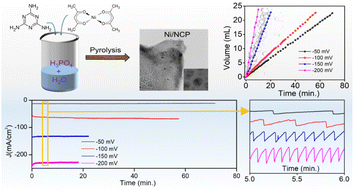
A dual heteroatom (N,P)-doped carbon nanostructure grafted on nickel nanoparticles synergistically enhances the catalytic effect for H2O adsorption during the hydrogen evolution reaction (HER). We developed a one-step pyrolysis route to synthesize N,P-codoped carbon grafted on Ni nanoparticles as an efficient electrocatalyst for H2 generation. The atomic size mismatch of N and P with C disrupts the sp2 carbon lattice, introducing defects. Furthermore, defect coalescence generates pores and abundant active sites, enabling excellent HER performance with an overpotential of only 41 mV at 10 mA cm−2 in 1 M KOH. We developed a custom setup to quantify the generated H2 as a function of applied potential using chronoamperometric measurements. The H2 generation rate increased with applied negative potential, reaching 3.60 mL mg−1 min−1 at −200 mV. The dynamics of ions for a highly efficient catalyst were further investigated using electrochemical impedance spectroscopy (EIS) at the same applied potential. The interconnected pores in the nanostructure facilitated the electroactive species to access internal active sites, consequently lowering the magnitude of impedance (|Z|imp). As the applied negative potential increased, a sharp decrease in |Z|imp indicated an improved HER kinetics, leading to faster reaction rates and enhanced performance.
 Please wait while we load your content...


