


 PLATFORM UPDATE:


Unravelling the transformation from a type-I to type-II MA3Bi2I9-based heterostructure photocatalyst via energy band engineering

Abstract
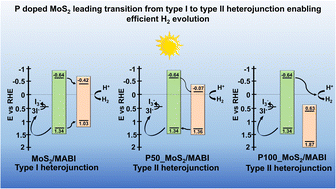
The photocatalytic dissociation of hydroiodic acid (HI) utilizing halide perovskites offers an environmentally benign and economically viable approach for hydrogen production under ambient temperature conditions. With lead-halide perovskites showing encouraging efficacy in the domain of photocatalytic hydrogen generation, this work focused on developing a lead-free Bi-based hybrid perovskite, specifically MA3Bi2I9 (MABI), which was successfully synthesized in a heterostructure configuration, wherein the MABI perovskite was in situ grown around amorphous MoS2. This research underscores that for heterostructures made of amorphous MoS2 and MABI, the doping of phosphorus not only modified the energy levels but it also altered the crucial bandgap values of amorphous MoS2. The shifted energy levels of MoS2 relative to MABI resulted in unique energy band arrangements for the three composites. A transition of the heterojunction from type I to type II was observed with the phosphorus-doped MoS2-containing composites. Among all three composites, P50_MoS2/MABI possessed advantageous band alignment, facilitating the most efficient photogenerated charge separation and transport. Under optimal reaction parameters, a hydrogen evolution rate of 1176 µmol g−1 h−1 can be attained for P50_MoS2/MABI composites.
 Please wait while we load your content...


