


 PLATFORM UPDATE:


Optimizing π-conjugated system of spiro-based HTMs; structures and concept towards boosting efficiency of PSCs
 af
Muhammad Adnan
Iqbal,
*ae
af
Muhammad Adnan
Iqbal,
*ae
Abstract
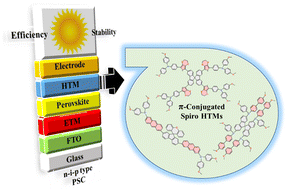
Perovskite solar cells (PSCs) have attracted significant attention due to their rapidly increasing power conversion efficiencies (PCEs), now exceeding 25.8%, along with low-cost fabrication and versatile material tunability. Among the core components of PSCs, hole transport materials (HTMs) play a pivotal role in enhancing charge extraction, suppressing recombination losses, and improving overall device stability. This review highlights the significant progress made from 2020 to 2025 in the development of new π-conjugated organic HTMs for perovskite solar cells (PSCs), with a particular focus on spiro-based structures. Traditional organic HTMs such as spiro-OMeTAD remain widely used, but their reliance on dopants and high cost has prompted the exploration of cost-effective, dopant-free alternatives. Notably, small molecules like TPE-NPD and polymeric HTMs such as PTAA have achieved PCEs exceeding 21%, offering enhanced thermal and chemical stability. Recent advancements in molecular engineering, such as π-conjugation expansion, donor–acceptor design, and the introduction of heteroatoms, have significantly improved hole mobility, film uniformity, and energy level alignment. This review not only summarizes these material developments but also analyzes charge transport mechanisms, interfacial optimization strategies, and stability trade-offs, highlighting promising design concepts for next-generation, efficient, and durable spiro-based HTMs in PSCs.
- This article is part of the themed collection: Sustainable Energy & Fuels 2026 Review Articles
 Please wait while we load your content...


