


 PLATFORM UPDATE:


Interfacial engineering of rhodium-complex-integrated COF photocatalysts for photo-redox co-factor cycling and selective CO2 reduction

Abstract
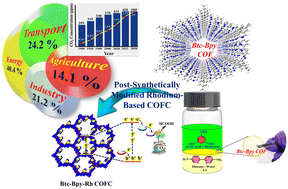
Solar-driven CO2 conversion into valuable chemicals is a promising strategy for sustainable energy and carbon management. In this work, a visible-light-active covalent organic framework (Btc–Bpy COF) film was synthesized via an interfacial strategy and evaluated as a photocatalyst for CO2 reduction to formic acid with coupled photo-redox co-factor cycling. The pristine COFs exhibited efficient photocatalytic performance, achieving formic acid production of 196.93 μM with 82.74% co-factor cycling (1,4-NADH) under visible-light irradiation. To further enhance catalytic efficiency, a rhodium-complex-integrated COF complex (Btc–Bpy–Rh COFC) was developed via post-synthetic metal coordination, while retaining the integrity of the covalent framework. The incorporation of rhodium provided well-defined catalytic sites and improved interfacial charge dynamics, resulting in enhanced activity and selectivity, with formic acid production up to 225.62 μM and 88.82% co-factor cycling. This study demonstrates that the interfacial engineering of COFs via rhodium-complex integration is an effective approach for improving photocatalytic CO2 reduction and co-factor cycling, serving as a benchmark example, marking the first reported use of this streamlined system for establishing a new standard for future advancements. Comprehensive spectroscopic and electrochemical analyses, including UV-vis diffuse reflectance spectroscopy, steady state and time-resolved photoluminescence, N2 adsorption–desorption, and electrochemical studies, were employed to investigate the optical properties, charge-transfer dynamics, and surface characteristics of the photocatalysts.
 Please wait while we load your content...


