


 PLATFORM UPDATE:


Robust optimization of microalgae cultivation using a dual-uncertainty quantified random forest-based EGO framework

Abstract
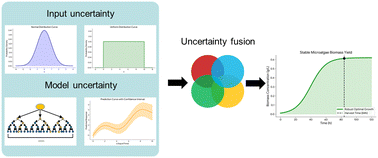
Numerous challenges in science and engineering arise from various uncertainties, including input, parameter, observation, and model uncertainties. Upstream processes in bioindustry, represented by microalgae, are usually completed under laboratory conditions, which leads to the fact that most optimization strategies fail to account for the uncertainty of process conditions in an industrial environment. Model-assisted techniques make it necessary to consider metamodel errors in the optimization process. This work introduces a robust optimization algorithm that takes into account input and model uncertainty. The algorithm identifies optimal solutions that are robust toward both input and model uncertainties, thereby ensuring the reproducibility of optimized experimental protocols and resilience against variations in harsh industrial environments. At the same time, to cope with the mixed input of multiple types of variables, the random forest model is chosen to replace the objective function. It also improves the computational efficiency. This work evaluates the performance and applicability of the proposed method through extensive benchmark studies and demonstrates its practical utility by optimizing a Chlamydomonas reinhardtii cultivation protocol involving significant experimental noise.
 Please wait while we load your content...


