


Screening of transaminases in a wall-coated microreactor plate

Abstract
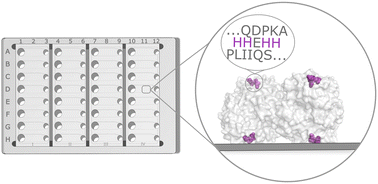
Microfluidics is a very attractive discipline for implementing more versatile high-throughput screening methods to improve enzymes. However, state-of-the-art microfluidics set-ups are mainly devoted to screening enzymes in solution, while screening of enzyme immobilisation protocols using microfluidics is scarce. In this work, we develop a versatile wall-coated microreactor (WCμR) plate for transaminase screening, integrating up to 32 poly(methyl methacrylate) (PMMA) WCμR functionalised with different metal chelates. The device is validated by screening His-tagged and His-clustered amine transaminase (ATA) variants that result in different orientations, evaluating a total of 30 unique biocatalyst-functionalisation combinations for activity, stability, and immobilisation efficiency. In batch mode reactions, H3A, H2A, and H4 ATA variants from Pseudomonas fluorescens, Chromobacterium violaceum, and Haelomonas elongata, respectively, immobilised on copper-chelates exhibit the highest scores based on fluorometer assays. This WCμR plate can be easily integrated with optical microscopes for spatiotemporal assays. Alternatively, these WCμRs are readily adapted for continuous biotransformation operating as flow microreactors. This capability is tested with a His-tagged ATA immobilised on the microchannels to continuously aminate 5-hydroxymethyl furfural, achieving a specific productivity of 0.49 molHMFA molATA−1 s−1 and a total turnover number of 9 × 10³, with a maximum space–time yield (STY) of 0.077 g L−1 d−1. This study highlights the potential of WCμRs for high-throughput enzyme screening and continuous biocatalysis, offering precise control over reaction conditions.
 Please wait while we load your content...


