


Recent advancement on heterogeneous metal catalysts for the upgradation of polyethylene terephthalate plastic waste into bis(2-hydroxyethyl) terephthalate

Abstract
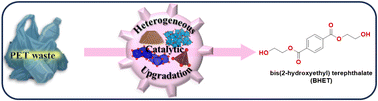
Polyethylene terephthalate (PET) is one of the most widely used plastics, yet its poor biodegradability has led to severe environmental accumulation. Chemical recycling via glycolysis offers a viable pathway to depolymerize PET into bis(2-hydroxyethyl) terephthalate (BHET), enabling closed-loop production of virgin-grade PET and its derivatives. In recent years, heterogeneous metal catalysts have emerged as highly efficient systems for PET glycolysis, offering advantages such as enhanced activity, selectivity, ease of separation, and reusability. This review critically examines recent advancements in heterogeneous metal-based catalysts, including transition metal oxides, mixed-metal oxides, supported nanoparticles, magnetic catalysts, and bifunctional acid–base materials. The influence of catalyst morphology, surface chemistry, and reaction parameters is discussed in detail alongside mechanistic insights. Challenges such as feedstock impurities, catalyst deactivation, and scale-up limitations are highlighted. By bridging materials innovation with process optimization, heterogeneous metal-catalyzed glycolysis presents a sustainable and scalable approach for transforming PET waste into a valuable monomer, aligning with circular economy and environmental sustainability goals.
 Please wait while we load your content...


