Photocatalytic Defluoroalkylation of Trifluoromethylaromatics with arylethylenes

Abstract

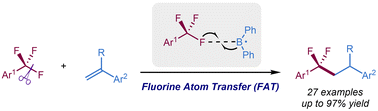
We present a novel fluorine atom transfer technique for the selective functionalization of robust C-F bonds in trifluoromethylated aromatic compounds. This approach employs neutral boron radicals to generate aryl difluoromethyl radicals through a C-F cleavage process. These radicals engage in highly effective intermolecular coupling with aryl alkenes throughout the defluoroalkylation process. This mild, catalytic reaction system accommodates a diverse array of substrates, producing difluoroalkyl structures of medicinal importance with total regioselectivity. Organofluorine compounds are pivotal in medicines, agrochemicals, and functional materials. 1 The fluorine atom's elevated electronegativity, diminutive atomic radius, and distinctive chemical, physical, and biological characteristics might augment a compound's hydrophobicity, lipophilicity, and solubility, while concurrently enhancing its metabolic or oxidative stability and bioavailability. 2 Difluoroalkyl groups are garnering heightened interest owing to their distinctive electrical properties and capacity to augment the biological efficacy of organic compounds. 3 At now, difluoroalkyl modification techniques have been effectively utilized in various commercial pharmaceuticals. 4 For instance, RWJ-671818 is an orally bioavailable α-thrombin inhibitor, 5 while BMS serves as a frequently utilized agonist (Scheme 1A). Moreover, trifluoromethyl compounds possess a diverse array of readily accessible sources. 6 Consequently, the selective cleavage of the C(sp 3 )-F link from accessible trifluoromethyl compounds to directly produce useful difluoromethyl compounds constitutes a technique that is both atom-and step-efficient. The primary problems of this approach stem from the elevated dissociation energy of the C-F bonds in polyfluorinated compounds (PhCF3, which has a C-F bond dissociation energy of roughly 115 kcal/mol) and the regulation of selective defluorination. 7 In trifluoromethyl groups, the bond energy of the residual C-F bond diminishes with the removal of each C-F link.In certain instances, all three equivalent C-F bonds may cleave concurrently, and C-F bonds in monofluorinated and Scheme 1. A) Difluoroalkyl drug molecules. B) The reported defluorination methods. C) Boron radical activation of C-F bond.
Supplementary files

Article information

Article type
Research Article
Submitted
22 Apr 2026
Accepted
13 May 2026
First published
14 May 2026

Org. Chem. Front., 2026, Accepted Manuscript

Photocatalytic Defluoroalkylation of Trifluoromethylaromatics with arylethylenes

S. Guan, Y. Zheng, Z. Cai and Y. Chen, Org. Chem. Front., 2026, Accepted Manuscript , DOI: 10.1039/D6QO00541A

To request permission to reproduce material from this article, please go to the Copyright Clearance Center request page.

If you are an author contributing to an RSC publication, you do not need to request permission provided correct acknowledgement is given.

If you are the author of this article, you do not need to request permission to reproduce figures and diagrams provided correct acknowledgement is given. If you want to reproduce the whole article in a third-party publication (excluding your thesis/dissertation for which permission is not required) please go to the Copyright Clearance Center request page.

Read more about how to correctly acknowledge RSC content.

Social activity

Spotlight

Advertisements