


Intrinsic carbon defect-engineered carbonized wood membrane electrodes for superior supercapacitors
 *abd
*abd
Abstract
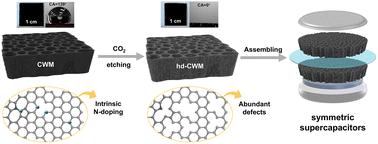
Carbonized wood membrane (CWM) has emerged as highly promising self-supported electrodes for supercapacitors (SCs) owing to their intrinsic vertical channel architecture and hierarchical porous structure. However, pristine CWM electrodes suffer from limited specific capacity, which is primarily derived from their intrinsically low specific surface area (SSA) and inferior electrolyte wettability. Herein, a highly defective carbonized wood membrane (hd-CWM) electrode was fabricated through CO2 thermal etching of pristine CWM. The as-prepared hd-CWM preserves the three-dimensional (3D) framework of CWM while introducing abundant carbon defects, leading to a significantly enhanced SSA (913.8 m2 g−1), increased pore volume (0.53 cm3 g−1), and superior electrolyte wettability (0° contact angle in 6 M KOH) compared to pristine CWM. Benefitting from these structural merits, the hd-CWM-based symmetric SC exhibits a remarkably high areal capacitance (Ca) of 1599.8 mF cm−2 at 1.0 mA cm−2, an energy density of 55.5 µWh cm−2 at a power density of 250.0 µW cm−2 within a potential window of 0–1.0 V, and excellent cycling stability with 100% capacitance retention after 10 000 cycles and unit coulombic efficiency at 10 mA cm−2. Notably, the operating potential window of the hd-CWM-based SC can be further extended to 0–1.3 V, resulting in significantly improved capacitive performance (1990.2 mF cm−2 at 1.0 mA cm−2, 80.3% capacitance retention at 50 mA cm−2, 99.8% capacitance retention after 5000 cycles, and energy densities of 116.8–93.8 µWh cm−2 at power densities of 325.0–17 775.0 µW cm−2). This work offers novel insights into the design and fabrication of self-supported carbon-based electrodes with high SSA, well-developed porosity, and superior electrolyte wettability for high-performance SCs.
 Please wait while we load your content...


