


Robust ultramicroporous MIL-160 enables efficient hydrogen isotope separation

Abstract
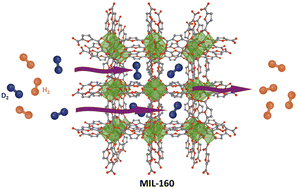
The separation of hydrogen isotopes remains a formidable challenge owing to their nearly identical molecular sizes and physicochemical properties. Here, we report MIL-160, an aluminum-based MOF featuring robust ultramicroporous channels, as an efficient adsorbent for hydrogen isotope separation. Benefiting from its uniform ultramicropores, MIL-160 exhibits quantum sieving behavior, as evidenced by higher D2 uptake and stronger host–guest interactions. The pelletized form, MIL-160-P, retains the intrinsic porosity of the pristine material. Dynamic breakthrough experiments demonstrate clear D2/H2 separation, achieving D2 enrichment in a single temperature-programmed desorption cycle. MIL-160-P thus combines structural robustness with high isotope selectivity, offering a good platform for practical hydrogen isotope separation.
 Please wait while we load your content...


