


 PLATFORM UPDATE:


Pore-wall functionalization of covalent organic framework palladium catalysts boosts the multicomponent reaction of CO2
 †*a
Jianhan
Huang
*a
†*a
Jianhan
Huang
*a
Abstract
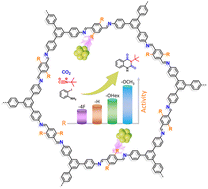
Although supported metal nanoparticles (NPs) have demonstrated great potential in heterogeneous catalysis, the regulation of their interaction with the support framework remains a significant challenge. Herein, we employed a pore-wall functionalization strategy to construct four covalent organic frameworks (COFs) with distinct chemical microenvironments. Palladium nanoparticles were incorporated into the frameworks (Pd@TA, Pd@TA-4F, Pd@TA-OCH3, and Pd@TA-OHex), and the materials were applied in the multicomponent reaction of carbon dioxide. Impressively, modifications in the pore-wall microenvironment exhibited a regular modulating effect on the catalytic performance of the Pd NPs. Among them, Pd@TA-OCH3, which combines electron-donating effects and low steric hindrance, demonstrated the best catalytic performance. Furthermore, due to the altered surface microenvironment, Pd@TA-OCH3 exhibited optimal enrichment and adsorption (k = 0.32 h−1) behavior toward the substrates. In-depth catalytic and adsorption experiments, along with DFT calculations, confirmed the structure–activity relationship between the microenvironments of the COFs and their catalytic performance.
 Please wait while we load your content...


