Structural design and functional characterization of dicationic pyrazolium salts as organic ionic plastic crystals

Abstract

A series of dicationic pyrazolium hexafluorophosphate (PF6) salts connected by a butylene bridge were synthesized with side linear alkyl chains ranging from C1 to C12. Thermal analysis revealed that most compounds exhibit one or more solid–solid phase transitions (Tss), and several compounds displayed clear characteristics of organic ionic plastic crystals (OIPCs), with entropy of fusion (ΔSf) values below 40 J mol−1 K−1. Among them, 1,4-bis[N-(N′-octylpyrazolium)]butane PF6 exhibited the softest plastic crystal morphology, as confirmed by polarized optical microscopy (POM) and wide-angle X-ray scattering (WAXS), and achieved a high ionic conductivity of 1.31 × 10⁻³ S cm−1 at 70 °C upon incorporation of 30 mol% lithium bis(trifluoromethanesulfonyl)imide (LiTf2N). These findings demonstrate that the structural tunability of dicationic pyrazolium salts plays a key role in modulating solid-state ionic conductivity, providing insights into the design of next-generation electrochemical materials.
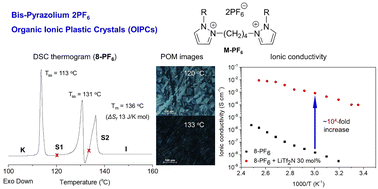
Graphical abstract: Structural design and functional characterization of dicationic pyrazolium salts as organic ionic plastic crystals

Supplementary files

Transparent peer review

To support increased transparency, we offer authors the option to publish the peer review history alongside their article.

View this article’s peer review history

Article information

Article type
Research Article
Submitted
23 Sep 2025
Accepted
11 Nov 2025
First published
13 Nov 2025

Mater. Chem. Front., 2026, Advance Article

Structural design and functional characterization of dicationic pyrazolium salts as organic ionic plastic crystals

J. C. Shin, S. Kim, E. Yun and M. Lee, Mater. Chem. Front., 2026, Advance Article , DOI: 10.1039/D5QM00697J

To request permission to reproduce material from this article, please go to the Copyright Clearance Center request page.

If you are an author contributing to an RSC publication, you do not need to request permission provided correct acknowledgement is given.

If you are the author of this article, you do not need to request permission to reproduce figures and diagrams provided correct acknowledgement is given. If you want to reproduce the whole article in a third-party publication (excluding your thesis/dissertation for which permission is not required) please go to the Copyright Clearance Center request page.

Read more about how to correctly acknowledge RSC content.

Social activity

Spotlight

Advertisements