


 PLATFORM UPDATE:


Single-atom engineering goldene for highly efficient and selective electroreduction of nitrate to ammonia
 *a
Tiancun
Liu,
*a
*a
Tiancun
Liu,
*a
Abstract
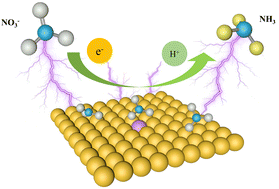
The electrochemical nitrate (NO3−) reduction reaction (NO3RR) is one of the promising strategies for converting nitrate into environmentally benign or value-added products. Here, single-atom catalysts (SACs) based on a gold monolayer (named goldene) for the NO3RR toward NH3 were investigated via density functional theory (DFT) calculations. Ti, V, Zr, and Mo@goldene follow the N-end mechanism with limiting potentials (UL) of −0.32, −0.18, −0.44, and −0.39 V, respectively. Notably, volcano plot reveals that NO3RR activity of TM@goldene is closely correlated with the adsorption free energy of NO3−. The formation of side products is significantly suppressed on these SACs. Additionally, NO3− adsorption performance is highly associated with the d band center, showing a linear relationship between the two. Differences in the number of transferred electrons cause variations in the adsorption strength between the intermediates and the TM site. Investigation into the origin of activity reveals that the TM atom and its six-coordinated Au atoms act as electron reservoirs and donors. The TM atom serves as the active site for the NO3RR, where adsorbed species acquire electrons to sustain the catalytic reaction. This study not only provides a new strategy for enhancing NH3 production using goldene-based SACs but also offers insights for the development of metal-based SACs.
- This article is part of the themed collection: Special issue for the 10th Asian Conference on Coordination Chemistry
 Please wait while we load your content...


